

News
Fire Guts Usmanu Danfodiyo University Aso Rock Hostel, Destroys Students’ Belongings

A fire outbreak yesterday Wednesday destroyed a students’ hostel popularly known as Aso Rock at Usmanu Danfodiyo University, Sokoto (UDUS), leaving several students without personal belongings and accommodation.
The incident occurred at about 1pm on November 18, 2026, at the hostel located in the Gidan Yaro area, behind the university stadium.
According to accounts from residents in the neighbourhood, the fire reportedly started on an adjoining farmland where a farmer was burning dried agricultural stalks and other farm waste.
The farmer allegedly set the farm residues on fire in an open area about 80 to 100 centimetres from the hostel, before the flames spread towards the building and eventually engulfed it.
A witness said he had earlier warned the farmer against setting the farm waste ablaze so close to the hostel, cautioning that the fire could spread to the building and neighbouring properties.
However, the warning was allegedly ignored.
The witness raised the alarm when the flames began spreading, prompting residents to contact the fire service.
Firefighters arrived at the scene about 20 minutes after the fire had engulfed the building.
Although the hostel accommodated students of UDUS, no occupants were reportedly inside when the incident occurred, as some students were attending lectures while others had yet to return for academic activities.
However, a student, who was temporarily staying in the hostel with a friend while arranging his own accommodation, was also affected.
The student was reportedly attending classes when the fire broke out, leaving his belongings, including academic credentials and other personal documents, inside the building.
Several properties, including clothes, electronic devices, academic materials and other valuables, were destroyed in the inferno.
The incident has left affected students facing the challenge of replacing their belongings and finding alternative accommodation.
The fire has also raised concerns over the practice of open burning of agricultural waste close to residential buildings, particularly in areas where students and other residents live.
…..mandates CNA tọ transmit Bill tọ Mr President
Senators have demanded a clear legal framework to coordinate Federal and State Police, warning that without it the new decentralised policing system could trigger jurisdictional clashes and political abuse.
The call dominated debate as the Senate resolved to transmit the State Police Bill, otherwise known as the Sixth Alteration Bill, 2026, to President Bola Tinubu for assent after approval by the National Assembly and all 36 State Houses of Assembly.
Leading the debate, the Senate Leader, Senator Opeyemi Bamidele, said both chambers passed the amendment in June and July 2026 with the required two-thirds majority, while all 36 State Houses of Assembly subsequently approved it in line with Section 9 of the 1999 Constitution.
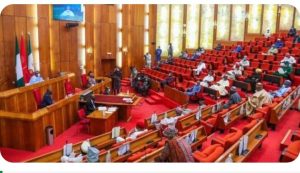
The Senate thereafter mandated the Clerk to the National Assembly to transmit the bill to the President for assent.
Senators, however, insisted that constitutional approval alone was not enough, stressing that the National Assembly must urgently enact a National Policing Bill to define how Federal and State Police will operate side by side.
Senator Adams Oshiomhole (Edo North) led the push for safeguards, acknowledging long-standing fears that governors could deploy state police to intimidate opponents and persecute perceived enemies.
Drawing from his experience as a former governor, Oshiomhole admitted he had once shared those fears.
He argued, however, that the risk of abuse should not be used to deny Nigeria the benefits of decentralised policing at a time kidnapping and violent crimes were worsening.
The lawmaker said the centralised structure had failed despite massive recruitment into the Police and military, given Nigeria’s size, population and the sophistication of criminal gangs.
He, therefore, proposed legislation that would spell out the respective responsibilities of Federal and State Police, establish clear areas of jurisdiction and prevent unnecessary clashes between the formations.
According to him, such a framework would regulate operations, ensure effective coordination and stop the two levels of policing from working at cross-purposes.
Senator Ekong Samson (Akwa Ibom South) backed the call, describing state police as a bold step for democracy but warning that its success would depend on strong checks.
Samson said concerns about governors abusing State Police were genuine and should not be dismissed.
He maintained that Nigeria needed a courageous and independent judiciary capable of checking abuse of power, protecting citizens’ rights and ensuring state police authorities operate within the law.
Without effective judicial oversight, he warned, the country might not derive maximum benefit from the new arrangement.
Other senators said decentralisation would bring security closer to the people, strengthen intelligence gathering and enable states to respond faster to local threats.
The Deputy Senate President, Senator Barau Jibrin, who chairs the Senate Committee on Constitution Review, said the new policing arrangement would complement rather than replace existing federal institutions.
He noted that successive administrations attempted State Police but failed to secure the required political and constitutional consensus.
The Senate approved two prayers: to transmit the Sixth Alteration Bill, 2026 to President Tinubu for assent, and to appreciate the President and urge him to forward the proposed National Policing Bill to provide the operational framework.
The Senate President, Senator Godswill Akpabio, clarified that the constitutional amendment already provides for an Act of the National Assembly to establish modalities for State Police and regulate their relationship with the Federal Police.
He said the proposed legislation would address jurisdictional conflicts, operational procedures, coordination and possible abuses raised by Oshiomhole and Samson, describing the 36 out of 36 endorsement by State Houses of Assembly as an extraordinary national consensus and a historic achievement of the 10th National Assembly.
The Senate yesterday Wednesday passed two landmark bills to boost research, innovation and postgraduate medical education in Nigeria.
The bills are the National Research and Innovation Development Fund Establishment Bill, 2026, and the National Postgraduate Medical College Act Amendment Bill, 2026.
This followed the consideration of reports on the two bills by the Senate Committee on Tertiary Institutions and TETFund, presented by its chairman, Senator Mohammed Dandutse (Katsina South) during plenary.
Dandutse said the first bill seeks to create a sustainable funding mechanism for research, development and innovation across the country.
He explained that it also provides for the establishment of the National Council on Research and Innovation.
According to him, the Council will provide strategic direction, policy oversight and supervision for the nation’s research agenda.
Dandutse said the proposed fund will support research institutions and provide a dedicated framework for tackling Nigeria’s development challenges.
He added that the fund and the council would work together to strengthen the country’s research, scientific, technological and innovation capabilities.
On the second bill, Dandutse said the amendment seeks to strengthen the institutional and academic functions of the National Postgraduate Medical College.
He explained that it will empower the college to establish academic programmes and award Doctor of Philosophy degrees in specialised medical disciplines.
The disciplines include clinical medicine, dentistry, basic medical sciences, pharmacology and other related fields.
Dandutse said the amendment will also empower the college’s Senate to develop, administer and supervise the doctoral programmes.
He stressed that the programmes will be subject to accreditation and regulation by the National Universities Commission (NUC) to ensure compliance with academic standards.
He said the amendment will strengthen advanced medical education, clinical research and the development of specialised medical expertise in Nigeria.
The Senate considered both bills clause by clause at the Committee of the Whole and adopted their provisions, and were thereafter read for the third time and passed.

The Nigeria Labour Congress, NLC, and the Trade Union Congress, TUC, have finally settled their public fight over the Federal Government’s N70,000 transport allowance.
The reconciliation was announced on Wednesday in Abuja at a joint press conference addressed by NLC President Joe Ajaero and TUC President-General Festus Osifo.
The two leaders, who had clashed openly on Channels Television’s The Morning Brief weeks ago, stood side by side to tell workers that the quarrel is over.
In a joint statement, they described the fight as a family misunderstanding that unfortunately spilled into the open. They said the unity of Nigerian workers is far greater than any disagreement between leaders.
“The unity of the Nigerian working class is far greater than any disagreement between leaderships. Our shared struggle and history must not be sacrificed over institutional differences,” the statement said.
They promised to work together with mutual respect, trust and cooperation in defending workers, pensioners and other vulnerable Nigerians.
The fight started over a N70,000 monthly transport support approved by President Bola Tinubu for government workers. The allowance is to run for six months to cushion the effects of rising cost of living.
The NLC accepted the allowance. The TUC rejected it.
TUC said workers do not need transport allowance. Rather, it said they need a real pay rise until talks on a fresh minimum wage are finished.
The disagreement burst into the open when Ajaero and Osifo appeared separately on Channels TV and clashed over who has the authority to negotiate with the government.
Ajaero argued that the NLC could negotiate on its own, citing the International Labour Organisation principle on the most representative workers’ organisation.
Osifo rejected that position and called the allowance deal announced by the NLC an aberration, saying the TUC was not part of the talks. He challenged Ajaero to show where ILO rules allow one labour centre to bargain for another.
He noted that the NLC has about 60 affiliates while the TUC has about 40. He also questioned whether the meeting where the allowance was agreed qualified as a valid session of the public service joint negotiating council, known as the JNC.
The public exchange raised fears that the disunity could weaken labour’s bargaining power ahead of the next minimum wage talks.
Peace was brokered by six former presidents of both labour centres, who intervened to bring the two leaders together.
Following the intervention, the Secretary to the Government of the Federation, George Akume, met with a TUC delegation led by Osifo on Tuesday, November 17. At that meeting, the government set up a high-powered committee to review the TUC’s concerns.
The committee includes three TUC representatives and officials from the Office of the SGF, the Office of the Head of the Civil Service of the Federation, the National Salaries, Incomes and Wages Commission and the Federal Ministry of Labour and Employment. It is expected to report within two weeks.
With the rift now closed, attention will shift to how the two centres coordinate their positions on pay and the minimum wage.
Nigeria’s minimum wage is currently N70,000 a month under the National Minimum Wage Act signed by President Tinubu in July 2024, which raised it from N30,000. The law requires a review every three years, putting the next round of negotiations due by mid-2027.
For millions of workers, N70,000 no longer goes as far as it did in 2024. Labour leaders say the united front will now give them a stronger voice to demand better pay.




-
News4 days ago
Ogata wife, Juliana Bello, confesses role in late Husband’s death- Police
-
News4 days ago
2027: Atiku storms Yobe despite ADC judgment, draws massive crowd
-
News3 days ago
Uni Abuja Staff, Students Protest Over Alleged Land Grabbing By Wike
-
News4 days ago
Insulate traditional Institutions from partisan politics – Oba Ladoja
-
News3 days ago
Show your evidence, Akpabio dares Amaechi over NDDC 50% cut claim
-
News3 days ago
President not stoned at Abuja mosque- aide counters claim
-
News3 days ago
State Police : Good to go, set for Tinubu’s assent…….as 36 Sub- National Govts approve Bill
-
News2 days ago
Contrary Spirits: Fountain of Life Church removes Jimmy Odukoya as senior pastor