

News
Insecurity: 3.726m Displaced Nigerians Live in 3,900 Camps- Report

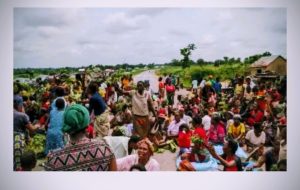
Nigeria is paying a heavy price for years of protracted insecurity, with 3,725,593 internally displaced persons, IDPs, now scattered across about 3,900 camps and settlements nationwide.
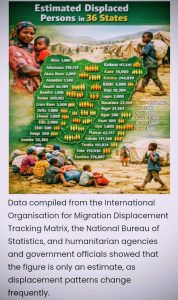
Data compiled from the International Organisation for Migration Displacement Tracking Matrix, the National Bureau of Statistics, and humanitarian agencies and government officials showed that the figure is only an estimate, as displacement patterns change frequently.
The crisis has largely been driven by insurgency in the North-East, banditry in the North-West, farmer–herder conflicts in the North-Central, and communal clashes in parts of the South.
Nigeria’s 3.726 million displaced population is larger than the population of at least 63 countries whose populations are under 3.7 million, according to United Nations population estimates.
Among countries with fewer than 3.7 million people are Uruguay (3.4m), Jamaica (2.8m), Qatar (2.7m), Namibia (2.6m) and Botswana (2.6m).
Across several northern states, the construction and maintenance of IDP camps have become a permanent feature, resembling conditions usually associated with wartime.
Although Nigeria operates a democratic system, many communities face realities akin to conflict zones, as persistent attacks continue to uproot families and destroy livelihoods.
Entire communities have been forced out of their ancestral homes due to repeated attacks by terrorists, bandits, killer herdsmen, cattle rustlers and kidnappers, who invade villages, destroy farms and abduct residents.
The result is the emergence of hundreds of displacement camps and thousands of homeless citizens who were forced out of their homes through no fault of theirs.
In the early years of the Boko Haram insurgency, Borno and Yobe states had the largest number of IDP camps.
However, the number has significantly declined, following resettlement programmes by the two state governments.
Borno, the epicentre of the insurgency, under Governor Babagana Zulum, systematically shut down many camps and resettled residents in their communities.
Currently, only the Madinnatu camp in Jere Local Government Area remains functional.
However, a recent attack in Ngoshe community in Gwoza LGA forced the authorities to open a temporary camp near Pulka to accommodate thousands of displaced residents.
More than 3,000 residents fled Ngoshe, while over 300 civilians, mostly women and children, were abducted during the attack.
Addressing displaced persons during a visit to the Pulka camp, Governor Zulum said: “We are here to commiserate with the people of Ngoshe who lost their loved ones, following the unfortunate incident that occurred last Tuesday. The situation is very sad and our hearts go out to all those affected by this tragedy.
“I want to assure you that we will do everything possible to address the unfortunate situation that has befallen this community.
“For now, we will distribute food items to those affected and I have directed that cooking points be established so that everyone in this community can receive meals from a central kitchen.”
Meanwhile, in Yobe State, under Governor Mai Mala Buni, all officially designated camps have been closed after displaced residents were resettled in their communities.
Zamfara hosts 276,887 IDPs in 9 camps
In Zamfara State, more than 276,000 residents have been displaced by persistent bandit attacks.
Reports indicate that at least 107 villages were overrun by bandits between 2009 and 2026, forcing thousands to flee to Gusau, the state capital.
Data from the Zamfara State Ministry of Humanitarian and Disaster Management showed that 276,887 IDPs were recorded as of March 2026.
Of this number, about 75 per cent have experienced multiple displacement, while only 18 per cent live in formal camps.
Major camps include Tsunami, Mareri, Lalan, Premier, Tudun Wada, Unguwar Gwaza and Anka camps, alongside 46 host community locations.
According to Malam Sani Aminu, an official in charge of food supplies at the Tsunami camp, the state government provides food items such as maize, millet and sorghum.
The Commissioner for Humanitarian Affairs, Salisu Musa Tsafe, said the number had reduced by about 89,000 as security improved, allowing some residents to return home.
Benue home to over 500,000 IDPs
According to the International Organization for Migration, Benue State hosts over 500,000 internally displaced persons, making it one of the worst-hit states.
The state currently operates 14 officially recognised camps.
The Commissioner for Humanitarian Affairs, Mr. Aondowase Kunde, said the government of Governor Hyacinth Alia was shifting from emergency relief to a long-term solution.
“The government is transitioning from temporary relief to a durable solutions framework, focussing on voluntary return, resettlement and reintegration.”
Authorities have begun building 60 permanent two-bedroom houses in Yelewata community, with plans to construct 5,700 homes for displaced residents.
Additionally, 600 hectares of farmland have been allocated to IDP farming cooperatives to promote self-reliance.
90,000 displaced in Taraba camps
In Taraba State, about 90,000 displaced persons are currently sheltered in eight camps located in Peva and Kufai Ahmadu in Chanchanji Ward of Takum LGA.
Many others have crossed into neighbouring communities in Benue State for safety. The crisis prompted a joint visit by Governors Agbu Kefas and Hyacinth Alia to affected communities.
However, investigations revealed that many camps lack basic amenities.
Justin Tyopuusu, Special Adviser to the Governor on Digital Economy, said the government was working to restore security so displaced residents could return home before the rainy season.
Kebbi shuts camps, resettles displaced residents
On its part, Kebbi State government said it currently had no active IDP camps, following successful resettlement of displaced residents, the activities of terror group, Lakurawa, notwithstanding.
Special Adviser on Communications, Abdullahi Idris Zuru, said camps previously located in Kebbi South were closed after security improved.
“We have been able to contain ceaseless attacks on our communities as joint armed forces patrols pushed back the terrorists,” he said.
He added that Governor Nasir Idris provided housing, food, clothing and medical support for the affected communities.
Kwara’s sole camp remains unused
In Kwara State, the only IDP camp established by the federal government in Patigi Local Government Area has never been used.
The North-Central Coordinator of the National Commission for Refugees Migrants and Internally Displaced Persons, Hajia Jumai Ahmed, expressed surprise at the development.
“Yes, there is an IDP camp established by the Federal Government at Patigi, but it has never been put to use,” she said.
Sources said Governor AbdulRahman AbdulRazaq preferred assisting victims directly through relief support and rehabilitation, rather than establishing camps.
Nasarawa hosts 5 camps
The Director-General of Nasarawa State Emergency Management Agency, Dr. Ben Akwash, said the state had five IDP camps, including the major camp at Ugya in Toto LGA.
Other locations include Kadarko and Giza in Keana LGA, Agyragu in Lafia LGA, and Doma in Doma LGA.
He explained that population figures fluctuate, depending on the level of communal clashes.
Thousands displaced in Plateau
In Plateau State, relentless attacks across the state have displaced thousands of residents. Communities in Mangu, Barkin Ladi, Bassa, Riyom, Jos South, Kanam and Wase have suffered repeated attacks.
Unlike other states, most displaced residents in Plateau live with relatives, rather than in formal camps, a system that preserves social ties but strains host families.
Governor Caleb Mutfwang has also launched a task force to facilitate the safe return of displaced residents. The government has also begun a housing project in Ribakwa village in Bassa LGA to resettle affected families.
Adamawa camps run by communities
In Adamawa State, the government closed all official camps as far back as 2014, allowing communities to run their own shelters.
Camps currently operate in Malkohi, Labondo, Bole, Fufore and Sangere Marghi, relying largely on NGOs, religious organisations and philanthropists for support.
Many displaced residents now depend on farming, trade and small businesses for survival.
Sokoto shelters 2,500 displaced residents
In Sokoto State, the government established a major IDP camp at Ramen Kura, within the state capital. The camp currently shelters over 2,500 displaced persons, mostly women and children, who fled terrorists’ attacks.
Officials said the camp was created as an emergency response to a surge in displacement from Gandi, Tureta, Goronyo and Gudu LGAs.
Although authorities provide food, water, healthcare and sanitation services, overcrowding and limited resources remain major challenges.
Estimated displaced persons in 36 states; Abia – 1,000; Adamawa -218,118; Akwa Ibom – 2,000; Anambra -1,500; Bauchi -66,489; Bayelsa -1,000; Benue – 500,182; Borno – 1,711,481; Cross River – 3,000; Delta -1,000; Ebonyi – 1,000; Edo -2,000; Ekiti – 500; Enugu – 500; Gombe – 52,383; and Imo – 1,000.
Others are Jigawa – 500; Kaduna -117,541; Kano -18,000; Katsina – 244,839; Kebbi -5,000; Kogi – 10,389; Kwara -1,500; Lagos -2,000; Nasarawa -23,104; Niger -21,393; Ogun – 500; Ondo – 500; Osun – 500; Oyo – 1,000; Plateau – 62,357; Rivers – 1,000; Sokoto -117,568; Taraba -101,834; Yobe -155,030; and Zamfara -276,887.
Courtesy Vanguard

The United States government has insisted that Nigeria should retain its Country of Particular Concern, CPC, designation, saying the country has not done enough to protect Christians from attacks.
Assistant Secretary of State for African Affairs, Frank Garcia, made this statement on Thursday during a congressional hearing on violence in Nigeria.
Garcia was responding to questions from US Congressman Riley Moore, who asked about the government’s efforts to dismantle militia strongholds and kidnapping camps in the Middle Belt, particularly in Benue and Plateau states.
Moore also raised concerns over the exclusion of the states from the forest guard initiative and delays in deploying 1,000 approved guards to Plateau.
“Before you answer that, we cannot take this CPC designation off of this country. They have not done enough,” Moore said.
Garcia acknowledged the lack of progress, but said Nigeria was taking steps to address the concerns, although they had yet to produce results.
He said the country’s security capacity was still being developed and that deployments were not happening fast enough.
“Unfortunately, the violence has not stopped,” Garcia added, citing continued attacks in Kaduna and Plateau states.
He said the US had provided police training and equipment, expanded intelligence sharing and worked with Nigerian financial institutions to disrupt terrorist financing.
Garcia added that Washington would continue diplomatic engagements and security cooperation to protect vulnerable communities and ensure accountability.
However, the Nigerian government has consistently rejected claims of a “Christian genocide” or targeted religious persecution, maintaining that insecurity affects Nigerians of all faiths.


Liquefied Petroleum Gas, commonly known as cooking gas, has risen significantly, forcing Nigerians to spend more to purchase the product.
The increase comes as depot owners and retailers raised their prices over the past two days.
StockGap increased its depot price by N25 to N1,440 per kilogram. Nigerian Independent Petroleum Company Limited, NIPCO, Mobil (now 11 Plc) and Ardova, on the other hand, sold the product at N1,400 and N1,390 per kilogram, respectively.
Similarly, LPG retail outlets, including Raniol, Juda Oil and Nigerian National Petroleum Company Limited, NNPC, outlets in Abuja and its environs, now dispense cooking gas at between N1,550 and N1,600 per kilogram, up from N1,400 and N1,500.
Micro-LPG dealers sell the product for between N1,700 and N1,800 per kilogram, depending on the location in Abuja.
Earlier, NIPCO’s spokesperson, Taofeek Lawal, had exclusively told DAILY POST that LPG prices could increase further between November and January next year.
The latest price increase means that Nigerians who previously spent N17,500 to refill a 12.5kg cylinder at N1,400 per kilogram will now pay N20,000 at the new rate of N1,600 per kilogram, representing an additional N2,500.
News
2027: Tinubu Must Withdraw ‘All Is Fair in Politics’ Remark, Embrace Peaceful Coexistence — ADC-PCC

The African Democratic Congress Presidential Campaign Council (ADC-PCC) has called on President Bola Ahmed Tinubu to publicly retract his controversial “All Is Fair in Politics” remark, warning that such rhetoric fuels political division, emboldens thugs and poses a grave threat to the nation’s peace and stability.
The ADC-PCC also expressed concern over what it described as the President’s disturbing silence on the conduct of some APC governors and party chieftains who have openly made inflammatory statements and allegedly encouraged political violence.
In a statement signed by its Director of Media and Publicity, Kola Ologbondiyan, the ADC-PCC urged President Tinubu to rise above partisan interests and demonstrate the statesmanship expected of a national leader, citing former President Goodluck Jonathan’s unequivocal declaration that no presidential ambition was worth the blood of any Nigerian.

The Council described as shocking the President’s failure to condemn the growing wave of political violence, noting that, through his spokesman, Mr. Bayo Onanuga, the Presidency had instead chosen to caution opposition parties while shielding those allegedly responsible for violence within the ruling APC.
“President Tinubu cannot claim to desire peace when his own words provide cover for violence.
“‘All Is Fair in Politics’ is not the language of a Head of State. It is the language of political desperation and an open licence for thuggery, ballot snatching, intimidation and bloodshed.
“From Edo to Cross River, Gombe to Lagos, and Kebbi to Kaduna, Nigerians have witnessed attacks on opposition gatherings, destruction of campaign materials and the brutalisation of innocent supporters, allegedly by APC-sponsored thugs.
“Yet, Mr. President has not considered it necessary to call his governors and party members to order.
“Instead, the Presidency has resorted to diversionary tactics, blaming victims and preaching restraint to the opposition while members of the ruling party are accused of unleashing violence across the country,” the statement said.
The ADC-PCC challenged President Tinubu to explain why his condemnation of political violence appears directed at the opposition rather than members of his own party.
It asked: “Why has Mr. President refused to condemn APC governors who openly threaten opposition supporters? Why has he remained silent over public incitement by officials of his party? Why is his anger always directed at the opposition and never at those within his own political fold?”
The Council maintained that the ADC remains committed to peaceful, issue-based political engagement, insisting that its campaign is focused on addressing the country’s pressing challenges, including hunger, insecurity, unemployment, corruption and what it described as the failures of the Tinubu administration.
It accused the APC of resorting to violence because it had little to offer Nigerians in terms of credible solutions to the country’s problems.
Consequently, the ADC-PCC demanded that President Tinubu immediately and publicly withdraw his “All Is Fair in Politics” remark, condemn and call to order APC governors and party officials accused of inciting violence, and direct security agencies to protect all Nigerians impartially rather than allow them to become instruments of intimidation and oppression against opposition parties.
” Nigeria belongs to all of us. No political ambition is worth the blood of any Nigerian.
“If former President Goodluck Jonathan could make that profound declaration in 2015, President Tinubu has no excuse not to say so and demonstrate the sincerity of his commitment to peace in 2026.
“The ADC will not be intimidated. We will continue to campaign peacefully, and in 2027, Nigerians will have the opportunity to vote for competence, integrity and a new beginning,” the statement added.





-
News5 days ago
IGP Disu decorates 29 senior police officers with new ranks….charges them on professionalism, integrity,others
-
News4 days ago
Airstrikes kill 40 ISWAP terrorists in Borno
-
News4 days ago
We finally received CTC Of Lifu’s Judgement, without Atiku, Other Candidates Names Mentioned—Senator Melaye
-
News4 days ago
2026 U-17 WWC: Tinubu rewards each Flamingos player with ₦100m
-
News5 days ago
How Federal High Court Chief judge is beign blackmailed with EFCC, CCB- ADC Campaign Council
-
News2 days ago
Crowd Shouts ‘Bamayi’ at Tinubu, pelt convoy in Abuja
-
News5 days ago
Oil slump opens door to cheaper petrol for Nigerians …as Brent hits lowest since August
-
News4 days ago
2027: APC sacks kindergarteen Campaign Spokespersons…..Yari, Alake, Idris, now to speak for council